- Plane ticket - 20,000 [round trip]
- JR pass - 9,000 [7 days]
- Accommodation - 9,000 (1,500*6) [6 nights]
- Food - 7,000 (1,000*7)
- Entrance fee - 3,500 (500*7) [visiting places]
Friday, August 1, 2008
Approximate costs...
General costs of the trip is around 48,500 Baht which is consisted of :


Wednesday, July 30, 2008
Here is the plan...
You know, it is impossible to fully understand a country in every aspects in only a week, which is the most possible length of time that we can go together, but it is fairly enough to get a general idea of what this country is like and here are the best places to spend our 7 days...

Day 1 : Arrive to Kansai international airport in Osaka, the second most important city of Japan...
Day 2 : Move to Nara, the first permanent capital of Japan with beautiful and peaceful nature...
Day 3 : Next to Kyoto, a magnificent capital of Japan for over thousand years, before Tokyo...
Day 4 : Ohayo gozaimasu fujisan... ~ (/^ 3^)/
Day 5 : The most beautiful temples and mysterious shrines are in this small village of Nikko...
Day 6-7 : Experiencing the modern Japan and enjoy fashion shopping, and return from Narita international airport...
Basic information
Osaka : With a population of 2.5 million, Osaka is Japan's third largest and second most important city. It has been the economic powerhouse of the Kansai region for many centuries. Osaka was formerly known as Naniwa. Before the Nara Period, when the capital used to be moved with the reign of each new emperor, Naniwa was once Japan's capital city, the first one ever known. In the 16th century, Toyotomi Hideyoshi chose Osaka as the location for his castle, and the city may have become Japan's capital if Tokugawa Ieyasu had not terminated the Toyotomi lineage after Hideyoshi's death and moved his government to distant Edo (Tokyo).
Osaka castle : Construction on Osaka Castle (Osakajo) started in 1583 on the former site of the Ishiyama Honganji Temple, which had been destroyed by Oda Nobunaga thirteen years earlier. Toyotomi Hideyoshi intended the castle to become the center of a new, unified Japan under Toyotomi rule. However, a few years after Hideyoshi's death, Tokugawa troops attacked and destroyed the castle and terminated the Toyotomi lineage in 1615. Osaka Castle was rebuilt by Tokugawa Hidetada in the 1620s, but its main castle tower was struck by lightening in 1665 and burnt down. It was not until 1931 that the present ferro-concrete reconstruction of the castle was built. Major repair works gave the castle new glamor in 1997. Inside the castle is a museum that documents Toyotomi Hideyoshi's life and the history of the castle.

Osaka aquarium : Osaka Aquarium, also known as Kaiyukan, is one of Japan's most spectacular aquaria. It introduces various forms of life inhabiting the Pacific Rim in a well organized and impressive way. Marine life is displayed in 15 tanks, each representing a specific region of the Pacific Rim. The central tank, representing the Pacifc Ocean, is nine meters deep and home to a whale shark, the aquarium's main attraction. Visitors start their tour of the aquarium on the 8th floor and slowly spiral down floor by floor around the central tank. Some of the tanks stretch over several floors, making it possible to observe the animals from different depths and perspectives.

Umeda sky building : The Umeda Sky Building is a spectacular high rise building in the Kita district of Osaka, near Osaka and Umeda Stations. It is also known as the "New Umeda City". The 173 meter tall building consists of two main towers which are connected with each other by the "Floating Garden Observatory" on the 39th floor. The observatory offers a great view of the city for a 700 Yen admission fee. The Takimi-koji restaurant mall, a replica of a Japanese street of the early Showa Period, can be found on the first basement floor. Offices occupy most of the building's other floors.

Nara : Japan's first permanent capital was established in the year 710 at Heijo, the city now known as Nara. As the influence and political ambitions of the city's powerful Buddhist monasteries grew to become a serious threat to the government, the capital was moved to Nagaoka in 784Nara is located in the Kinai plain, less than one hour from Kyoto and Osaka. Due to its past as the first permanent capital, it remains full of historic treasures, including some of Japan's oldest Buddhist temples.
Todaiji temple : Todaiji was constructed in 752 as the head temple of all provincial Buddhist temples of Japan and grew so powerful that the capital was moved from Nara to Nagaoka in 784 in order to lower its influence on government affairs. Not only is Todaiji housing Japan's largest Buddha statue (Daibutsu), but it is also the world's largest wooden building, even though the present reconstruction of 1692 is only two thirds of the original temple's size.
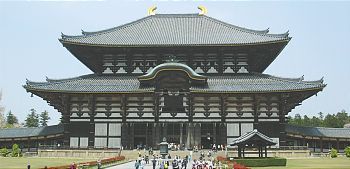
Nara park : Nara Park (Nara Koen) is a large, pleasant park in central Nara, established in 1880. It is the location of many of Nara's main attractions including Todaiji, Kasuga Taisha, Kofukuji and the Nara National Museum, a museum specialzed in Buddhist art. The park is home to hundreds of freely roaming deer. Considered messengers of the gods in Shinto, Nara's deer have become a symbol of the city and have even been designated a National Treasure.

Kofukuji : Kofukuji used to be the family temple of the Fujiwara, the most powerful family clan during much of the Nara and Heian Periods. The temple was established in Nara at the same time as the capital in 710. At the height of Fujiwara power, the temple consisted of over 150 buildings.Today, a couple of buildings of great historic value including a three and a five storied pagoda remain. The five storied pagoda is one of Japan's tallest and the symbol of Nara. Kofukuji's Treasure House exhibits part of the temple's great art collection
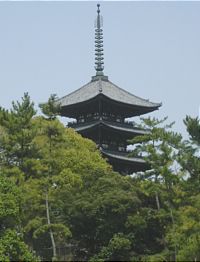
Kyoto : Kyoto was Japan's capital and the emperor's residence from 794 until 1868. It is now the country's seventh largest city with a population of 1.4 million people and a modern face. Over the centuries, Kyoto was destroyed by many wars and fires, but due to its historic value, the city was dropped from the list of target cities for the atomic bomb and spared from air raids during World War II. Countless temples, shrines and other historically priceless structures survive in the city today.
Kinkakuji : Kinkakuji (Golden Pavilion) is a Zen temple formally known as Rokuonji. In 1397 construction started on the Golden Pavilion as part of a new residence for the retired shogun Ashikaga Yoshimitsu. Kinkakuji was converted into a Zen temple after Yoshimitsu's death in 1408. The Golden Pavilion functions as shariden, housing sacred relics of the Buddha and is covered in gold leaf. The present building dates from 1955 as the pavilion was burnt by a fanatic monk in 1950.
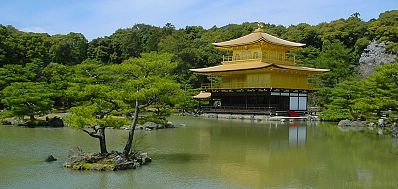
Fushimi Inari shrine : Fushimi Inari Shrine is the most famous of several thousands of shrines dedicated to Inari across Japan. Inari is the Shinto god of rice, and foxes are thought to be his messengers. Therefore, many fox statues can be found at Inari shrines. Fushimi Inari Shrine is also famous for the countless torii gates, offerings by worshippers, that cover the hiking trails of Inarisan, the wooded mountain behind the shrine's main buildings. It takes about two hours to walk along the whole trail. Kitsune Udon ("Fox Udon"), a noodle soup topped with pieces of aburaage (fried tofu), a favorite food of foxes, is served at small restaurants along the hiking trail.

Gion : Gion is Kyoto's most famous geisha district. To experience the traditional Gion, stroll along Hanami-koji, a street lined by beautiful old buildings, teahouses and restaurants. In the evenings, you may be able to spot a geisha apprentice. Yasaka Shrine and the Minamiza kabuki theater are some of Gion's other attractions.

Hakone : Hakone is part of the Fuji-Hakone-Izu National Park, less than 100 kilometers from Tokyo. Famous for hot springs, outdoor activities, natural beauty and the view of nearby Mt. Fuji, Hakone is one of the most popular destinations among Japanese and international tourists looking for a break from Tokyo.
Ashi lake : Lake Ashi (Japanese: Ashinoko) was formed in the caldera of Mount Hakone after the volcano's last eruption 3000 years ago. Today, the lake with Mount Fuji in the background is the symbol of Hakone. The best views of the lake in combination with Mount Fuji can be enjoyed from Moto-Hakone, from the Hakone Detached Palace Garden and from the sightseeing boats cruising the lake. Note however, that clouds and poor visibility often block the view of Mount Fuji, and you have to consider yourself lucky if you get a clear view of the mountain. Visibility tends to be better during the colder seasons of the year than in summer, and in the early morning and late evening hours. Two companies, Hakone Sightseeing Boats and Izuhakone Sightseeing Boats, operate boats between Moto-Hakone and Hakonemachi at the lake's southern shores and Togendai and Kojiri at the northern shores. A boat cruise from one end of the lake to the other takes roughly 30 minutes and costs 970 Yen. The Hakone Free Pass is valid on the pirate ship shaped Hakone Sightseeing Boats but not on boats operated by Izuhakone.

Hot springs : Hakone has been one of Japan's most popular hot spring resorts for centuries. Nowadays, more than a dozen springs provide hot spring water to the many bath houses and ryokan in the Hakone region. Yumoto, at the entrance to the Hakone area near Odawara, is Hakone's most famous hot spring with a particularly long history, high quality water and numerous baths and inns. But many more hot spring baths can be found in the valleys and mountains of Hakone and at the shores of Lake Ashi. Visitors can enjoy a hot spring bath in a public bath house or ryokan, as many ryokan open their baths not only to staying guests but also to daytime visitors. While staying guests can use the baths for free, daytime visitors pay an admission fee of typically between 500 and 2000 Yen.

Toshogu shrine : The Toshogu is the mausoleum of Tokugawa Ieyasu, founder of the Tokugawa shogunate, which ruled Japan for over 250 years until 1868. The shrine is dedicated to the spirits of Ieyasu and two other of Japan's most influential historical personalities, Toyotomi Hideyoshi and Minamoto Yoritomo. The lavishly decorated shrine complex consists of more than a dozen Shinto and Buddhist buildings set in a beautiful forest. Initially a relatively simple mausoleum, Toshogu was enlarged into the spectacular complex seen today by Ieyasu's grandson Iemitsu during the first half of the 17th century.

Rinnoji temple : Rinnoji is Nikko's most important temple. It was founded by Shodo Shonin, the Buddhist monk who introduced Buddhism to Nikko in the 8th century. The temple's main building, the Sanbutsudo, houses large, gold lacquered, wooden statues of Amida, Senju-Kannon ("Kannon with a thousand arms") and Bato-Kannon ("Kannon with a horse head"). The three deities are regarded as Buddhist manifestations of Nikko's three mountain kami ("Shinto gods") enshrined at Futarasan Shrine. Opposite Sanbutsudo stands the temple's treasure house with Buddhist and Tokugawa related exhibits. Shoyoen, a small Japanese style garden, is located next to the treasure house.

Futarasan shrine : Futarasan Shrine was founded in 782 by Shodo Shonin, the Buddhist monk who introduced Buddhism to Nikko and who also founded nearby Rinnoji Temple. Futarasan Shrine is dedicated to the kami ("Shinto gods") of Nikko's three most sacred mountains Mt. Nantai, Mt. Nyoho and Mt. Taro. Two more Futarasan Shrines stand at the shore of Lake Chuzenji and on the summit of Mount Nantai.

Shibuya : Shibuya is one of the twenty-three city wards of Tokyo, but often refers to just the popular shopping and entertainment area around Shibuya Station. Shibuya is one of Tokyo's most colorful and busy districts and birthplace to many of Japan's fashion and entertainment trends. Most of the area's large department and fashion stores belong to either Tokyu or Seibu, two competing corporations. A prominent landmark of Shibuya is the large intersection in front of the station (Hachiko Exit), which is heavily decorated by neon advertisements and giant video screens and gets crossed by amazingly large crowds of pedestrians each time the traffic light turns green.

Ginza : The Ginza is Tokyo's most famous upmarket shopping, dining and entertainment district, featuring numerous department stores, boutiques, art galleries, restaurants, night clubs and cafes. One square meter of land in the district's center is worth more than ten million yen (more than 100,000 US dollars), making it one of the most expensive real estate in Japan. It is where you can find the infamous $10 cups of coffee and where virtually every leading brand name in fashion and cosmetics has a presence. From 1612 to 1800, today's Ginza district was the site of a silver coin mint (Japanese: ginza), after which the district was eventually named. The Ginza evolved as an upmarket shopping district following the 1923 Great Kanto Earthquake. A visit to the Ginza is most pleasant on a weekend afternoon, when the central Chuo Dori gets closed to traffic and become a large pedestrian zone. The closure takes place from 14:00 to 17:00 on Saturdays and from 12:00 to 17:00 on Sundays (until 18:00 from April through September).

Akihabara : Akihabara (short: Akiba) is a district in central Tokyo, famous for its many electronics shops. In recent years, it has also gained fame as a center of the gaming, manga and animation culture. A major redevelopment of Akihabara Station and surroundings is nearing its completion, giving Akihabara a new face.

Harajuku : Harajuku refers to the area around Tokyo's Harajuku Station, one station north of Shibuya on the Yamanote Line. It is the center of Japan's most extreme teenage cultures and fashion styles, but also offers shopping for grown-ups and some historic sights. The focal point of Harajuku's teenage culture is Takeshita Dori (Takeshita Street) and its side streets, which are lined by many trendy shops, fashion boutiques, used clothes stores, crepe stands and fast food outlets geared towards the fashion and trend conscious teens. In order to experience the teenage culture at its most extreme, visit Harajuku on a Sunday, when many young people gather around Harajuku Station and engage in cosplay ("costume play"), dressed up in crazy costumes to resemble anime characters, punk musicians, etc.

Asakusa : Asakusa is the center of Tokyo's shitamachi, lit. "low city", one of Tokyo's few districts, which have preserved a certain atmosphere of the old Tokyo. Asakusa's main attraction is Sensoji, a very popular Buddhist temple, built in the 7th century. The temple is approached via the Nakamise, a shopping street that has been providing temple visitors with a variety of traditional, local snacks and tourist souvenirs for centuries. Asakusa can be easily explored on foot. Alternatively, you can consider a guided tour on a rickshaw (jinrikisha, lit. "man powered vehicle"). A 30 minute tour for two persons costs around 8000 Yen. Shorter and longer courses are also available.

- Shinjuku : Shinjuku is one of the 23 wards of Tokyo, but the name commonly refers just to the large entertainment, business and shopping area around Shinjuku Station. Handling more than two million passengers each day, Shinjuku Station is Japan's busiest railway station, served by six railway companies and about a dozen railway and subway lines, including the JR Yamanote Line.
Tuesday, July 29, 2008
Before any steps...
 I had a chance to visit Japan for about three weeks with P(Prat) on December 2007. We traveled through many Japan sightseeings in 12 provinces from southern to northern Japan, so we can pretty much tell where the best places are. Some of our friends told me that they are passionate to go there which they roughly planed to go after this fall semester. I also would love to revisit again, so it maybe nice if we can make it another eba trip. If we have only a week to feel Japan as much as possible, I suggest we should try visiting each day in Osaka, Nara, Kyoto, Hakone, Nikko and two days of shopping in Tokyo. These are the highlight of this country.

So, this is it...
Do you want to go to Econ trip...
It is not the poll result here that says this is the end of our third eba trip, but everybody change their minds to go to the Econ trip, even Benz do, after I personally talk to every single one of you. So, to Rayong!!! ~ ( ^ @ ^)/

Definitly yeah! | 2 (66%) |
Hell nooooo... | 1 (33%) |
Don't ask me. I ain't know nothing. | 0 (0%) |
It is not the poll result here that says this is the end of our third eba trip, but everybody change their minds to go to the Econ trip, even Benz do, after I personally talk to every single one of you. So, to Rayong!!! ~ ( ^ @ ^)/

[Reseed] Econ or eba...
Guys, I just heard it from Benz an hour ago that the econ trip in Rayong is coming up on August, 8th-10th which overlaps with our eba trip. Because it is econ trip, some of our friends from other groups may attend, and it might be a good idea to join them so that we all could get closer. However, we are now senior and have already become antiques ( yes, you've to start admitting it. It's not just me anymore ), and there is probably no place or activity for old people like us there which is certainly boring. My question is simply asking you whether you would want to go to econ trip or you are still in our eba trip. For example, I am okey with the majority, either place is fine by me, but Benz has a very strong preference on Go Bang Sa-re where he is definitly not going to Rayong with the kids even ..... drags him ( ask Benz for what is in the blank ). So, guys, tell me what you think...
[Reseed] Vote Result...
Where to go...
Well, we have two choices. Go Bang Sa-re which is the most possible choice with chill environment and such a low costs,right :), and Go Somewhere else which none of our companions indicate where that somewhere else could be... So, our eba trip 3 is automatically 'Go Bang Sa-re', wins with two votes. If any of you guys have any objections, please feel free to add it in comment. I beg you, tell me as soon as possible, then we can make adjustments to assure everybody's satisfaction, jub jub...
Timing, the most influential variable, as the last one of us come back to Thailand on August, 3rd and our next semester begins on August, 11st, we have 10 days between that. He/She probably wants to rest for a few days before we take off, so I suggest the trip should take place on 6th - 10th which is about 4 days and 4 nights. The activities wouldn't be much different from the first trip but I think we can find some new things to try such as real fishing, clubbing and alcohol gaming. As I said 6th - 10th of August, so make yourself available...
Group members seem to be only the 5 core members at the moment where, I believe, everybody are bored of the others' faces already, so I encourage you guys to invite your friends some more to join the team as the sake of diversity...
Conclusion, are you happy with Go Bang Sa-re or not? and invite your friends to join. That is it for now...
Go Bang Sa-re | 2 (33%) |
Go Mae Hong Son | 1 (16%) |
Go Trang | 1 (16%) |
Go Hongkong | 0 (0%) |
Go Somewhere else | 2 (33%) |
Well, we have two choices. Go Bang Sa-re which is the most possible choice with chill environment and such a low costs,right :), and Go Somewhere else which none of our companions indicate where that somewhere else could be... So, our eba trip 3 is automatically 'Go Bang Sa-re', wins with two votes. If any of you guys have any objections, please feel free to add it in comment. I beg you, tell me as soon as possible, then we can make adjustments to assure everybody's satisfaction, jub jub...
Timing, the most influential variable, as the last one of us come back to Thailand on August, 3rd and our next semester begins on August, 11st, we have 10 days between that. He/She probably wants to rest for a few days before we take off, so I suggest the trip should take place on 6th - 10th which is about 4 days and 4 nights. The activities wouldn't be much different from the first trip but I think we can find some new things to try such as real fishing, clubbing and alcohol gaming. As I said 6th - 10th of August, so make yourself available...
Group members seem to be only the 5 core members at the moment where, I believe, everybody are bored of the others' faces already, so I encourage you guys to invite your friends some more to join the team as the sake of diversity...
Conclusion, are you happy with Go Bang Sa-re or not? and invite your friends to join. That is it for now...
[Reseed] Where to go...
Since we all want to go somewhere after everybody come back to Thailand, around early August, I suggest we should democratically vote for where we want to go. Here are some suggestions as far as I know where you guys wanna hang out...
1. Go Bang Sa-re : it's real fishing this time!! ( remaking the eba trip 1)
2. Go Mae Hong Son : explore the universe!! ( star gazing )
3. Go Trang : dive into the deep blue sea!! ( seaing why 30 black whales chose to visit Thai Un Daman)
4. Go Hongkong : Hongkong shopping festival!! ( 01 June - 21 Oct 2008 )
5. Go somewhere else : you name it...
I personally prefer to go anywhere but the sea because it's rainy season!? We also went to Bang Salae in the first trip during this period of year, but we got stuck in a boat when we went out squid diving and fishing at night which was an experience. You know, we prefer this kind of experience only once in a life time...
Now, what we do is to vote and tell me your preferences. Once we can decide on where to go, I wish the person who are dying to go there could help me find information and do reservation...
 the beautiful sun and sky really energized the team.
eba trip 2, Go Chiang Mai
--------------------------------------------------------------------------------------------------
Note for those who have never been traveling with us, we are a non-profit world class traveling agency who provide a secured and comfortable trip through the globe with a reasonable price. This 3rd trip is solely requested by those who have been traveling along with us during these 3 years. We welcome every one to join our fun, warm and adventurous eba trip :)
Here are our participants
eba trip 1st, Go Bang Sa-re : Aong, Benz, Tu, It, Hong, P, Planin, Hao
eba trip 2nd, Go Chiang Mai : Aong, Benz, Tu, It, Hong, Ness, Kak, Chao
eba trip 3rd, Go Somewhere : Aong, Benz, Tu, It, Hong, You...
Subscribe to:
Posts (Atom)


